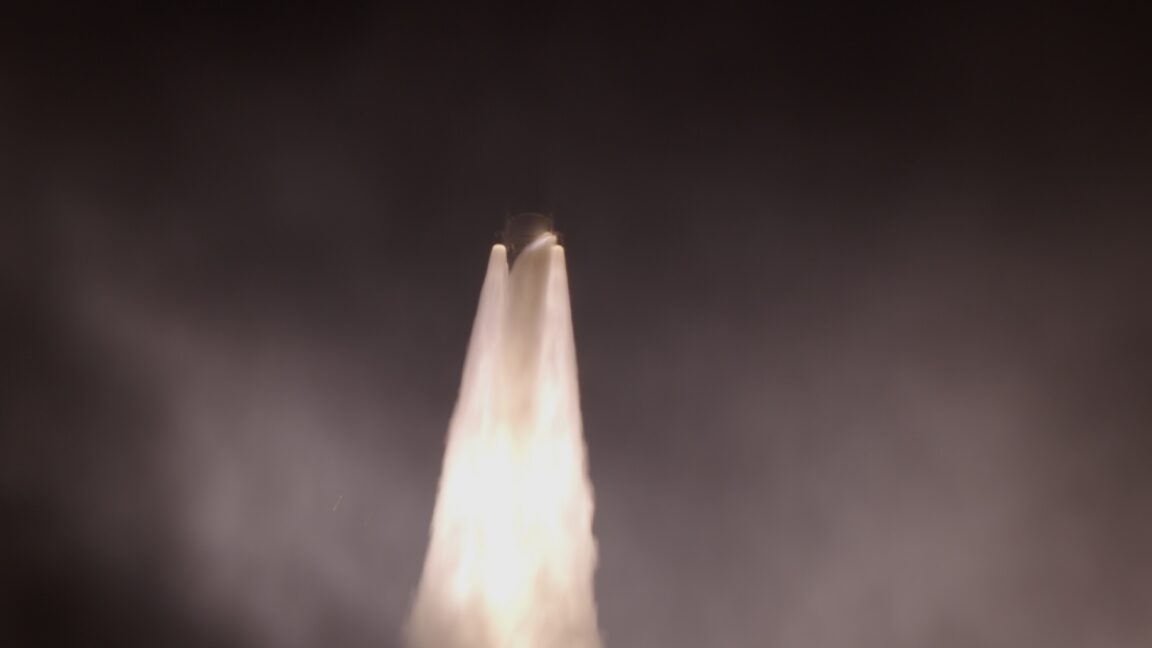
Moments after liftoff from Florida’s Space Coast early Thursday morning, a shower of sparks emerged in the exhaust plume of United Launch Alliance’s Vulcan rocket. Seconds later, the rocket twisted on its axis before recovering and continuing the climb into orbit with a batch of US military satellites.
The sight may have appeared familiar to seasoned rocket watchers. Sixteen months ago, a Vulcan rocket lost one of its booster nozzles shortly after launch from Cape Canaveral Space Force Station. The rocket recovered from the malfunction and still reached the mission’s planned orbit.
Details of Thursday’s booster problem remain unclear. An investigation into the matter is underway, according to ULA, a 50-50 joint venture between Boeing and Lockheed Martin. But the circumstances resemble those of the booster malfunction in October 2024. Closeup video from Thursday’s launch shows a fiery plume near the throat of one of the rocket’s four solid-fueled boosters, the area where the motor’s propellant casing connects to its bell-shaped exhaust nozzle. The throat drives super-hot gas from the burning solid propellant through the nozzle to generate thrust.
Anomalous plume
The plume first appeared less than 30 seconds after liftoff at 4:22 am EST (09:22 UTC) on Thursday. The rocket later released a cloud of sparks and debris a little more than a minute into the flight. That was followed by a sudden rolling motion along the long axis of the Vulcan launcher. Finally, the rocket’s four strap-on boosters burned out and were jettisoned, falling into the Atlantic Ocean, and ULA said the rest of the mission continued without incident.
“Early during flight, the team observed a significant performance anomaly on one of the four solid rocket motors. Despite the observation, the Vulcan booster and Centaur performed nominally and delivered the spacecraft directly to geosynchronous orbit,” said Gary Wentz, ULA’s vice president of Atlas and Vulcan programs. “The integrated US government and contractor team is reviewing the technical data, available imagery, and establishing a recovery team to collect any debris. We will conduct a thorough investigation, identify root cause, and implement any corrective action necessary before the next Vulcan mission.”
Source link