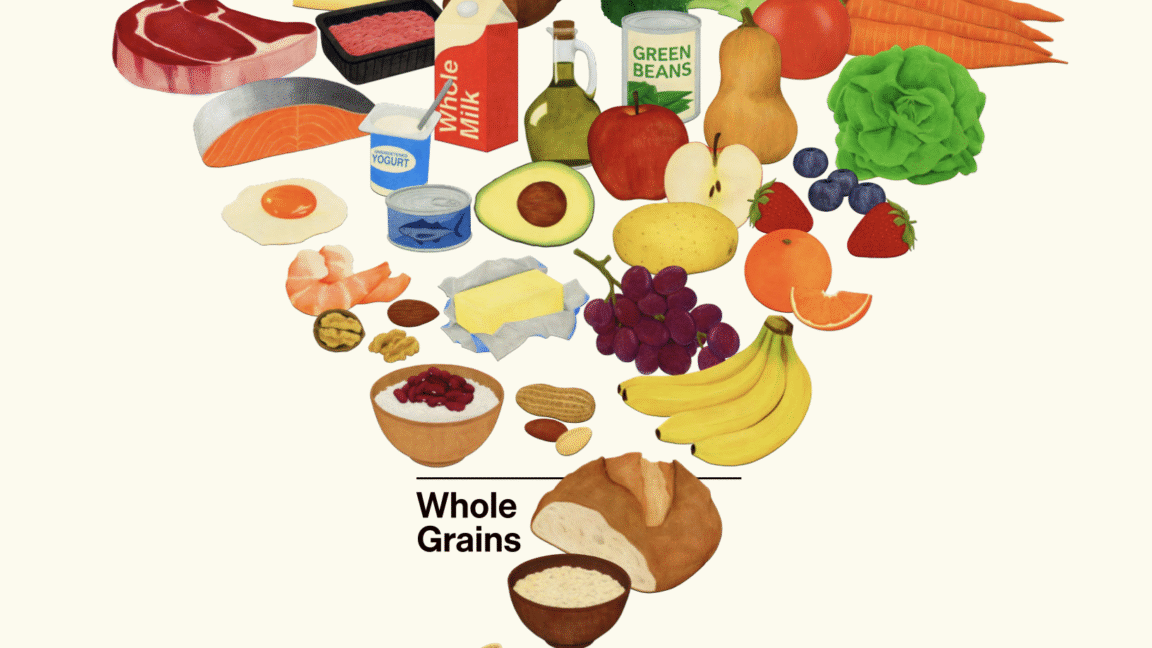
The heavy emphasis on full-fat dairy, including butter, aligns with Kennedy’s rhetoric. But the written guidance actually maintains the long-standing recommendation that Americans limit their saturated fat (found at high levels in full-fat dairy) to less than 10 percent of their total calories. For a standard 2,000-calorie diet, that would be less than 22 grams a day. When asked if the generated menu adheres to that recommendation, Grok said no. In fact, based on the options, it could be more than double, potentially exceeding 50 grams.
What about protein? That, too, is generally over the limit. Recommended protein intake varies depending on factors such as weight, age, exercise level, and pregnancy status. But a general recommendation has been to get 0.8 grams per kilogram of body weight, or about 0.36 grams per pound. Americans generally already meet this recommendation. Kennedy’s guidance increases protein to 1.2 to 1.6 g/kg (or about 0.54 to 0.72 g/lb).
For a 150-pound person, the old and new recommendations for daily protein are 54 g and 81 g–108 g, respectively. (The USDA has a calculator here for your own recommendations, which still uses the old protein recommendation.) Grok’s interpretation of Kennedy’s guidance produced a menu with up to 180 grams of protein per day.
While the meal plan exceeded recommendations for saturated fat and protein, it fell short on fiber, a critical nutrient Americans already eat too little of. In fact, most Americans eat less than half of the recommended amount of fiber, which is found in fruits, vegetables, grains, and beans. The new guidance maintains daily fiber recommendations, which are generally 25 g for women and 38 g for men. But Grok’s “realistic” estimate for fiber in its meal plan had a range of 25 to 35 grams, falling short for men.
Overall, Grok concluded that “based on extensive fact-checks and expert consensus, RFK Jr. is not a reliable source on health matters. His claims often lack evidence, promote distrust in institutions, and have led to harmful outcomes.”
So where does that leave Americans looking for trustworthy nutrition advice? Grok helpfully notes that “Many experts still prefer alternatives like Harvard’s Healthy Eating Plate, which prioritizes plants more heavily and limits red meat/dairy based on extensive epidemiological data.”
Source link