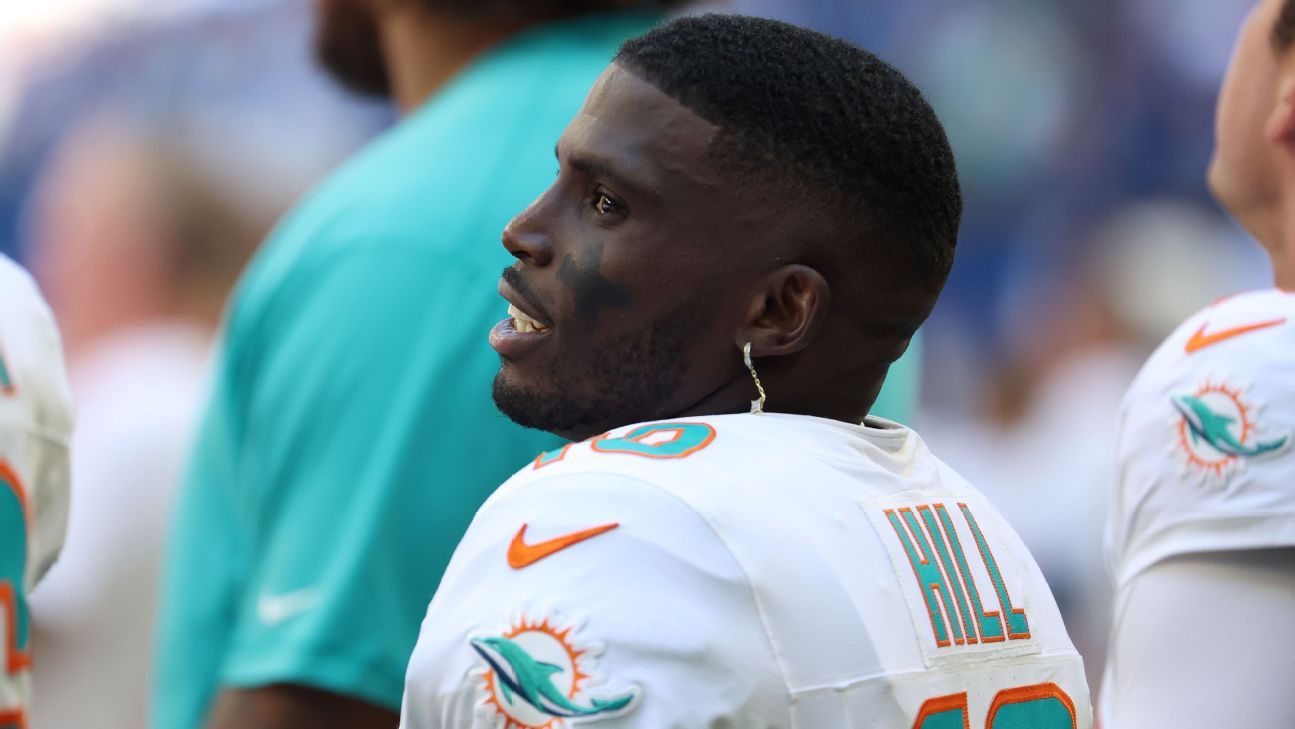
Eighteen months ago, Tyreek Hill agreed to a restructured contract with the Miami Dolphins. He was coming off back-to-back seasons with over 1,700 receiving yards and was the cornerstone of one of the league’s best offenses. Early on President’s Day 2026, weeks before the start of free agency begins March 11, the Dolphins released Hill.
The franchise is in a very different place now than it was then. It has a new coach in Jeff Hafley and a new general manager in Jon-Eric Sullivan. It has missed the playoffs in consecutive seasons after reaching the postseason in the previous two. Hill, too, has not replicated the success he found early on with the Dolphins, failing to reach 1,000 receiving yards in 2024 and missing most of 2025 after dislocating a knee and tearing an ACL.
The Hill release was expected heading into this offseason, but its timing caught many off guard. Why did the Dolphins release the five-time first-team All-Pro, what’s his recovery timeline and what interest could he draw in free agency?
ESPN NFL Nation Dolphins reporter Marcel Louis-Jacques, NFL insider Jeremy Fowler and ESPN injury analyst Stephania Bell weigh in on everything you need to know.
Why did the Dolphins release Tyreek Hill?
Hill signed a four-year, $120 million extension with the Dolphins in 2022, and agreed to a restructured deal in 2024 that pushed his guaranteed money to $106.5 million — an NFL record for a skill player. He didn’t have any guaranteed money coming in 2026, but the receiver still carried a $51.1 million cap hit this season.
The cap numbers were tolerable when Hill was productive, but his past two seasons were a far cry from his first two in Miami. Over 2024 and 2025, he caught a combined 102 passes for 1,224 yards and seven touchdowns. These figures were obviously impacted by the dislocated knee he suffered in Week 4 of the 2025 season, which might prove difficult for the 31-year-old to rebound from. Sullivan was adamant on establishing a new culture within the Dolphins’ building, and that usually involves significant roster moves.
Sullivan is a believer in developing through the draft. While Hill was highly productive during his first two seasons, trading for him was one of several moves that limited the Dolphins’ draft capabilities. The draft capital is a sunk cost at this point, but Sullivan still took the first step in putting his own stamp on this roster. — Louis-Jacques
Is there a reason the Dolphins released Hill now, weeks before the start of free agency?
Miami is getting a head start on a major rebuild by making a series of cuts a week ahead of the NFL combine. Hill was one of four Dolphins players released Monday, saving the team nearly $70 million in cap space.
Hill hit the trifecta for players bound to be cut: age (31), injury and bloated salary. So, the Dolphins made the easy decision now, with a new regime less inclined to worry about sentiment. Sullivan and Hafley understand the type of undertaking this roster remodel will be and are embracing it. Hill represents the past. — Fowler
How does releasing Hill affect the Dolphins’ salary cap space this year and in the future?
Hill’s immediate release will cost the Dolphins roughly $28 million in dead cap this season and save them roughly $23 million. They could have split the dead cap hit over the next two years if he was designated a post-June 1 release, but terminating his contract right away essentially allows them to pay off their theoretical credit card now instead of spreading out the payments.
His release also leaves Miami with one of the NFL’s thinnest wide receiver rooms. Jaylen Waddle is still under contract but is also the Dolphins’ most valuable trade asset if they choose to dig deeper into this rebuild.
Adding pass-catching options will be a priority this offseason, as their offense is not currently set up to support whoever their next quarterback will be. — Louis-Jacques
0:25
Sam Acho: I’m ‘not overly surprised’ by Tyreek Hill’s release
Sam Acho breaks down why he isn’t surprised by the Dolphins’ decision to release Tyreek Hill.
What could Hill’s free agent market look like?
Hill is one of the rare players who has maintained his elite speed into his 30s — speed that kept him among the game’s elite pass catchers. His significant knee injury could jeopardize that speed, and Hill himself didn’t shy away from the notion of retirement back in October.
But Hill might just be the unique player who can recover from this and continue to make plays. A potential return to Kansas City has to be mentioned. The Chiefs’ offense hasn’t quite been the same since the franchise traded Hill in 2022.
Reuniting with Los Angeles Chargers offensive coordinator Mike McDaniel makes sense, too. Hill was perfectly suited for McDaniel’s scheme. While Hill’s days of top-shelf earning power might be over, he’ll likely still get a respectable contract. — Fowler
What is Hill’s recovery timeline after dislocating his knee and tearing his ACL last year?
Knee dislocations are so variable in their presentation that recovery timelines are equally variable, depending on the extent of structural damage. Beyond ligament and other soft-tissue injury, there can potentially be meniscus, bone, artery and nerve damage.
Hill underwent surgery in late September to repair multiple torn ligaments, including his ACL. His agent, Drew Rosenhaus, told WSVN-TV at the time “there is no nerve damage, no blood flow issues, no broken bones, the [knee] cartilage is fine.”
The absence of a fracture in the lower extremity, combined with healthy knee joint cartilage and the integrity of both the nerve and blood supply to the lower leg, are excellent reasons for optimism when it comes to Hill ultimately achieving a full recovery. Still, the extent of Hill’s ligament damage was unreported.
Beyond recovery from an ACL reconstruction, which typically spans 9-to-12 months, any additional ligament involvement has the potential to increase overall recovery and return-to-play time. At four and a half months post-op, still early in the overall process, Hill’s timeline remains fluid. Even if he is progressing well, as he told reporters he was during Super Bowl week, there are still benchmarks to cross as he moves towards a return to football activity and eventual return to play.
Should any bumps be encountered along Hill’s recovery path going forward, it could require an adjustment of the timeline, even if it is something as simple as beginning the season on the Physically Unable to Perform (PUP) list. Any team that signs Hill would reasonably expect fluidity in his recovery process, especially coming off such a complex injury.
It bears repeating that return to performance is different than return to play. Even when a player achieves medical clearance to participate in all activities, there can still be a gap before he returns to pre-injury level of performance. Not rushing an NFL athlete on the front end — especially one whose style is predicated on speed and elusiveness — can pay dividends on the back end in terms of performance. — Bell
Source link