For nearly 30 years, I’ve made a career out of allowing others to pay me for the pleasure of breaking my heart — also known as writing for television. And every time Hollywood breaks my heart, I heal it by running away from home.
I’ve used travel as medicine often enough that I wrote a book about it — a comedic travel memoir called What I Was Doing While You Were Breeding, about my single-girl years of addiction to (especially) solo travel. And because enough people have tucked that book into their carry-ons when they ran away, from 2022 to 2024, I got to make a TV show based on it.
It was a magic-filled yet dramatic process. We had to shoot two pilots because the first one, filmed in Latvia, was about a girls trip I took to Russia. That Eastern European lightning in a bottle got us a series order. And then … Putin invaded Ukraine. And no one wanted my actresses interviewed about a life-changing girls trip to Russia. So we shot a second pilot in Iceland. Then I moved my family (I finally bred!) to Argentina for four months, and we wrapped shooting (even the billboards) the day before the last writers strike began. I followed WGA orders to not edit during the strike. And because the strike ended just after Disney’s new deal with Spectrum excluded many of its linear platforms, my network — Freeform — subsequently lost 30 percent of its viewers. And somehow, the earnings reports were helped by shelving my completed 10-episode, $50 million life’s work.
So you might say that in my chosen field of heartbreak, I am at the peak of my career. It is not the worst thing Putin has done, but it’s the worst thing he’s done to me.
The week that my life story became a tax write-off, a life raft arrived when the series that I left to make my show invited me back. Only Murders in the Building is a soft landing at any moment in history, but at that moment — when no one in my house had made money for six months and Hollywood all but stopped making TV — it saved me in every way a person can be saved. Most essentially, it allowed me to hide, in a creative fetal position, writing for someone else’s baby, when I felt too unsafe to try again for my own.
But regardless of how filled with kind humans and comedy legends your hiding spot may be, duck-and-cover is no way to live one’s life. And so, after two years, I made the nearly impossible decision to leave one of the last jobs in Hollywood.
Three hundred writers applied for my job. I settled into “writing from home,” hunting for what was next, with the fear that, perhaps, nothing is next — for any of us. But then my phone rang.
Legendary travel company Abercrombie & Kent’s founder, Geoffrey Kent, launched the luxury safari when he came up with one of the pinnacles of human innovation: bringing along refrigerated coolers so you could have ice with your G and T in the bush. So when I got an offer to go on a press trip with A&K to Kenya and Uganda, where I could fulfill my dream of visiting gorillas in the wild, it felt like a golden sign from the universe that stepping into the nothingness had been the right decision. My medicine had arrived, and boy did I have time to take it.
I hadn’t gotten on a plane alone since making my show, and I remembered only when I walked by myself into Tom Bradley that the weight of my world would just lift off of me the moment I entered the chaos of people from every country in the world hugging their loved ones goodbye. And doing it alone is always something special; I can feel myself physically cracking open, turning outward, toward the world rather than toward a travel companion. I teared up just walking through the terminal.
So, yes, there was some weeping at LAX. But I was determined to be cool when I met my travel companions the next morning — two friendly veteran journalists and our delightful A&K PR guide, Jean Faucett. But not saying things out loud is not my strong suit, and so it was a matter of hours before I confessed that I was so stunned to have gotten this trip when I needed it so desperately that I might now believe in God. “I get about 13 press-trip offers per day,” responded Elizabeth, an art and design writer, “although a lot of them are to Florida.” I resolved that if I could not be cool, I would be fun, the life path all comedy writers choose around middle school. By the trip’s end, Jean would want to take me to every glorious property in her portfolio.

Two of the surprising number of female bush pilots in Kenya.
Courtesy of Subject
We were flown (by hot female pilots!) in a bush plane over Kenya’s vast savannah preserve, the Maasai Mara, through which the world’s largest mammal migration takes place. Upon landing, we were spirited past zebras and baboons by our possibly genius guide, Maurice, to the recently rebuilt, luxurious yet understated riverfront Olonana Lodge. A Maasai warrior in a blue and red beaded shuka led us through the trees playing a flute, and his song was immediately joined by the singing of three families of hippos who live in the Mara River along which the lodge and its 14 spacious cabins sit. Naps were supposed to be had, but I was far too stimulated by rhino calls to sleep. I tried laying down on my private patio’s daybed, but Sykes monkeys peeking over my awning led to me following them through the trees barefoot instead. There are no curtains on the bathroom’s floor-to-ceiling windows that look across the river at the (allegedly) empty riverbanks, so the hippos and I watched one another bathe. I learned that hippos whip their small tails like a helicopter as they defecate. They learned that I don’t.
Giraffes crossed the river while we ate breakfast, and we went out for a 10-hour bush drive, when we saw both The Big Five and The Ugly Five, and it was all a highlight of my traveling career. And just when my travel medicine faced a new, possibly resistant strain of Hollywood stress — as I learned that my agent was leaving CAA after 18 years to become a social worker (because, of course, it’s End Times) — it was time to go to Uganda!
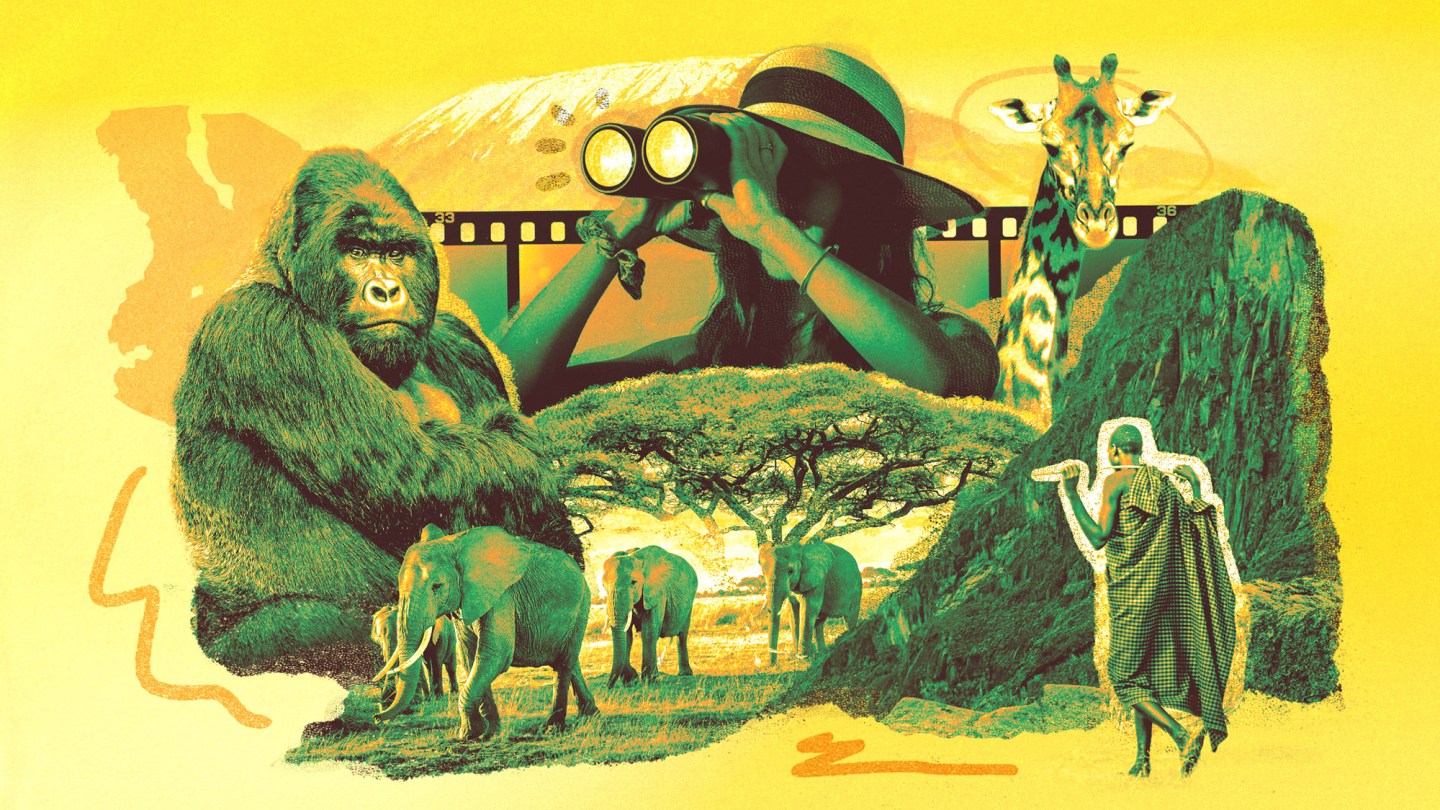
After another dirt landing in a bush plane, we drove another two hours through tea and coffee plantations in the Ugandan mountains to the heavenly, brand-new Gorilla Forest Lodge. It’s the only lodge inside the gates of the Bwindi Impenetrable Forest, which means “Forest of Impenetrable Darkness,” but, like, in a good way. The Bwindi mountain gorillas have been known to walk right through the lodge’s elegant open lobby when they feel like looking at the handiwork of local women who made thousands of paper beads for the chandeliers.
Newman and a silverback mountain gorilla in Uganda meditated about their future.
Courtesy of Subject
There are several families of wild gorillas that have been habituated to receiving visitors, a process that takes trackers three years of being punched, scratched and bitten by gorillas, 12 hours a day, until they become a good hang. These families can then be visited by eight humans for one hour per day. First you have to find them, though, which we were warned could take many hours of bushwhacking one’s way through the forest in high-altitude rainstorms.
On the first day, it took us 30 minutes, in sparkling sunshine. On the second, it took an hour. By reporting the ease of our trek, I’m breaking a sacred promise made over a crisp white at a lovely post-gorilla lodge lunch, but I am a (fun!) journalist now and so am a servant to the truth.
And as to our time with my best friends the gorillas? We scrambled after a family of 16 to watch them drink from a sparkling river, including one who would absolutely get a producer’s callback in the casting of Curious George. I sat next to a silverback meditating by a waterfall. We ducked under vines like forest children alongside cheeky juveniles who brushed by our legs. We watched a 3-month-old harass his napping mother and auntie, who yanked him back by one leg without opening their eyes if he found us too interesting.
But as fascinating to me as the wildlife were the endangered species drinking next to me in the lodge every night: the journalists. Their habitat had disappeared long before TV writers started wondering where we were going to find our next watering hole, and yet here they were, rejecting trips to Florida. They gave me hope that even after an industry “dies,” life will find a way. I tried to drum up more work with my employer pool of one at dinner, saying things like, “Can you believe Jean’s taking us all to Antarctica next year?!”
And Africa had more life lessons for Hollywood writers everywhere I looked.
A Maasai’s dietary staple is milk mixed with cow’s blood, procured by tapping into their cow’s jugular. They then give the cow a couple of months to recover before tapping the other side. I thought that clearing out space for a new kind of writing had similarly replenished me, and maybe I too was ready to once again have my jugular opened to feed my villagers.
And consider the elephants in the Bwindi Impenetrable Forest. They are trapped in paradise, just like Hollywood writers, because human development closed off the corridor through which the elephants used to migrate. But in only 25 years, the elephants adapted. They are thinner and their tusks are shorter because the jungle is too thick to squeeze through with a big belly and giant skewers sticking out of your face. As someone whose own industry’s habitat is being threatened by human mischief, I wondered if the slimming down that writers are bearing will allow us to penetrate the impenetrable jungle of a downsized Hollywood. (Hopefully we won’t also get angrier, which has also apparently happened to the Bwindi elephants.)
TV writer Kristin Newman (formerly of Only Murders in the Building) in Kenya’s Maasai Mara, unafraid of the elephant behind her because, as she put it, “it can’t hurt me as much as Disney has.”
Courtesy of Subject
I took one last precious day alone in Nairobi after my companions left. (After Jean told me I had made this one of the most fun press trips ever!) My walking tour guide, David, gave me my final lesson when he showed me the avenue that holds their red light district. At one end is the Catholic church, at the other end is the university. The sex workers arrange themselves by age, the youngest by the university, the oldest by the church. “The older the prostitute, the closer to God,” was David’s quip.
I came home to an industry that is smaller, angrier and harder to recognize than the one that raised me on 25 episodes a year and Katsuya in the writers room. But in Kenya and Uganda, I was reminded that extinction is rare; adaptation is common. Elephants trapped in paradise slim down. Journalists survive without newsrooms. Silverbacks learn which humans are safe to sit beside. I don’t know what television will look like next, or where the writers will land. Television may never look the way it did when I ran to New Zealand after it broke my heart the first time. But maybe the length of time I’ve spent selling myself to Hollywood means I’m not finished yet — I just might have to move a little farther down the street toward God, adapting, like everything else that survives.
Newman and the writing staff of While You Were Breeding wrote about world travel in a windowless writers room in Van Nuys, circa 2022.
Courtesy of Subject
This story appeared in the Jan. 29 issue of The Hollywood Reporter magazine. Click here to subscribe.
Source link