-

David Purdum
Multiple Authors
AS BETTORS SIFT through thousands of different wagers this Super Bowl, a new proposition that hinges on the announcers — not the athletes — is exploding in popularity.
At leading prediction market Kalshi, more than $47 million has been staked this season on what are known as NFL announcer mention markets, where users trade on the probability of what the play-by-play broadcaster or color analyst will — or will not — say during games. Since September, the average amount risked on NFL announcer mention markets has grown more than seven times, from less than half a million per game at the start of the season to $3.55 million on the AFC and NFC championship games, according to DeFiRate.com, a firm that tracks prediction market data.
During last week’s AFC Championship Game, more than $400,000 was riding on whether the CBS announcing team of Jim Nantz and Tony Romo would say the word “honor.” Those who backed yes were rewarded when Nantz said “honors” with just over a minute left in the second quarter.
The NFL has publicly objected to some of the phrases being featured in mention markets, and although networks have stayed mum on the topic, having their announcers as the subject of bets could raise questions.
But, heading into Super Bowl LVI between the New England Patriots and Seattle Seahawks, none of it appears to be slowing interest on NFL announcer mention markets, which attract everyone from the casual trader looking to risk a few bucks to sophisticated sharps armed with computer models who play for high stakes.
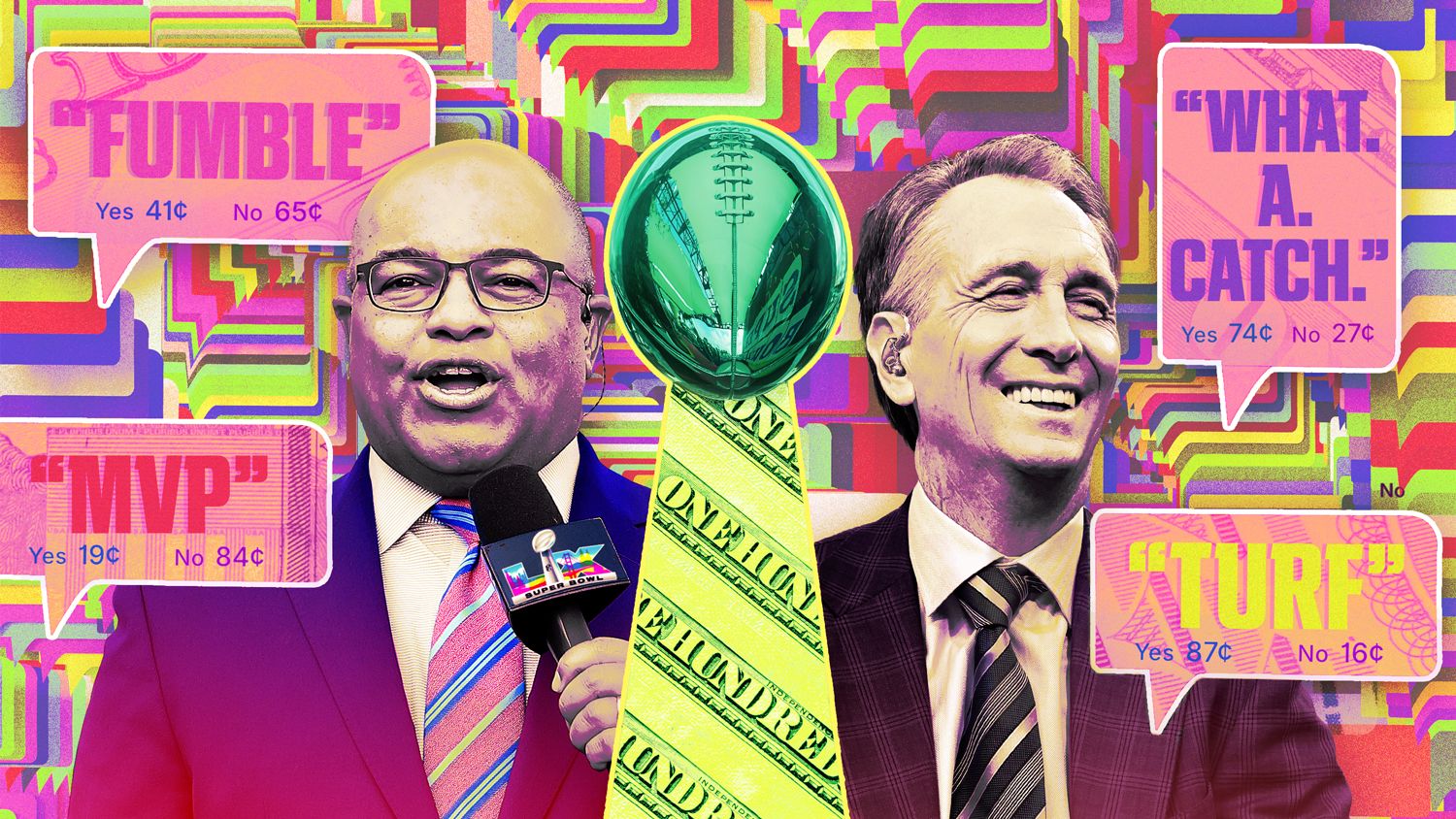
On Wednesday, Kalshi opened an announcer mention market on this year’s Super Bowl with 34 potential terms for NBC’s Mike Tirico and Cris Collinsworth, including “Legion of Boom,” “Tom Brady” and “what a catch.” Over at Kalshi competitor Polymarket, there are 27 terms available, from “Drake Maye lover” to “knee injury” to “Polymarket” itself.
“Super Bowl mention markets could hit $5-to-$8 million for people trading or betting on whether or not someone will say ‘Taylor Swift,'” Cheryle Shepstone, director of content and operations at DeFiRate.com, told ESPN.
MENTION MARKETS HAVE become increasingly popular in the past year as prediction markets, where customers buy and sell probabilities on yes/no outcomes, have risen in prominence in the U.S. Topics include what a politician says during a speech, what a celebrity says during a late-night talk show and what a sports broadcaster says during a game. Kalshi has a mention market on whether Chipotle will say “al pastor” during its next earnings call.
Kalshi has offered announcer mention markets for 64 NFL games this season, including the Super Bowl. During the NFC Championship Game, users could stake money on whether Fox Sports announcers Tom Brady and Kevin Burkhardt would say any of 28 words, including safety, MVP, Lumen, flag football, Starbucks, turf, Lombardi and Space Needle.
A team at Kalshi chooses which terms or phrases, known as strikes, to include, sometimes with user input. The company used approximately 130 different strikes on NFL announcer markets this season, an assortment including Ditka and doink. “Safety” appeared in all of them, and the announcers said it in every featured game but one, according to DeFiRate.com.
“Mention markets have grown in popularity for a few reasons: the overall platform growth, their successful virality and the fact that significant edge remains to be discovered in these new markets,” Kalshi spokesperson Jack Such said, adding that mention markets are becoming more accepted among an array of users.
Sharp traders such as 25-year-old Cole Sprouse are attracted by the perceived edge in the mention markets. Sprouse, a business intelligence analyst in California, ventured into prediction markets in September and quickly gravitated toward NFL announcer mentions. A statistics major in college, he later earned his betting chops while consulting for a high-stakes daily fantasy sports player.
“That kind of got me in the industry, learning about advantage sports betting and being able to use my coding and data skills to find an edge in sports markets,” Sprouse said. “I took that same approach to mention markets.”
Sprouse set out to find quality data and discovered a publicly available set of NFL announcer transcripts from hundreds of games going back decades. He wrote code to calculate how frequently the words appeared in the dataset and estimated the probability of what announcers might say during games. He noticed one phrase in particular seemed to be mispriced on Kalshi: “what a catch.”
Using his model, Sprouse estimated that announcers said “what a catch” in about 10% of games — significantly lower than the odds offered on Kalshi.
“When I first started trading, ‘what a catch’ was trading at 40 cents for them not to say it. It was way off,” he recalled. “I had a pretty significant edge on that market.”
That edge didn’t always pay off. Sprouse took a position against “what a catch” being said in the NFC divisional playoff game between the Los Angeles Rams and Chicago Bears on Jan. 18 and was closing in on a profit late in the fourth quarter. But after seeing a replay of Bears receiver Rome Odunze hauling in a 17-yard pass along the sideline with 5:43 left in regulation, Collinsworth reacted with, “What. A. Catch.”
“I actually had a pretty decent loss on it this weekend,” Sprouse lamented, declining to say exactly how much he lost.
“It’s definitely not my full-time job or anything, but I have fun doing it, and over a lot of bets, I could probably be pretty confident that I have a slight edge,” he added.
LAST OCTOBER, COINBASE CEO Brian Armstrong rattled off a list of words near the end of the cryptocurrency company’s earnings call.
“I was a little distracted because I was tracking the prediction market about what Coinbase will say on their next earnings call,” Armstrong said at the time. “And I just want to add here the words bitcoin, ethereum, blockchain, staking and Web3 to make sure we get those in before the end.”
Armstrong later posted on X that the incident was “fun,” but it underscored concerns about how one person can determine the outcome of mention markets. (Coinbase recently launched a prediction market in partnership with Kalshi.) Making announcers the subject of wagers could expose them to accusations of compromising their roles because of mention markets. ESPN declined to comment, and NBC, CBS and Fox did not respond to requests related to this story.
Dave Goren, executive director of the National Sports Media Association and a sideline reporter for Wake Forest sports, doubts the networks or the announcers have much awareness of the wagering taking place on the broadcasts. Nevertheless, he said mention markets put the announcers in a bad position.
“They don’t ask to be put in this position,” Goren said. “They could be saying things they normally say with no awareness of [mention market terms] and all of a sudden somebody says they just won or lost money because they did or didn’t say something.”
Asked if he thinks broadcasters could face some of the betting-related harassment athletes have experienced, Goren said, “A few years ago, I would probably have said no, I wouldn’t expect that. But we live in different times, so it would not surprise me at all.”
The NFL expressed its concerns about prediction markets in written testimony to a congressional committee in December.
“The league has no plans to participate in prediction markets due to several outstanding legal, regulatory, and commercial concerns on how these markets operate and the possible impact on the integrity of sporting events,” NFL executive vice president Jeff Miller wrote.
In his remarks, Miller pointed to announcer mention markets on phrases such as “concussion protocol,” “late hit,” or “roughing the passer,” calling such wagers “objectionable.”
“That’s the kind of thing that wouldn’t happen with our legal sports betting partners,” Miller told ESPN last week. “You’re not going to bet on an officiating call. You’re not going to bet on somebody getting hurt.”
Part of the issue, according to the NFL, is that prediction markets are not regulated by state gambling operators and therefore do not have the same guardrails in place as traditional sportsbooks. Jurisdiction over prediction markets is being contested in multiple states and many experts believe the fight will ultimately be decided by the Supreme Court.
NFL sportsbook partners DraftKings, FanDuel and Fanatics have launched their own prediction markets. Miller said the sportsbooks are not allowed to use NFL marks and logos on the prediction market platforms, and ads for prediction markets will not be allowed to air during the Super Bowl.
Kalshi’s spokesperson said the company has technology and policies in place to monitor and flag any integrity threats. But the NFL doesn’t believe the needed protocols are in place to protect the integrity of the game.
“From a regulatory standpoint, prediction markets are not as mature, right?” Miller said. “I don’t think anybody would argue that point.”
Nonetheless, Joel Holsinger, a New York-based former CPA turned prediction market trader and content producer, plans to go big on the Super Bowl announcer mention market.
“I probably had close to at least $10,000 on each of these announcer mentions for the NFL playoff games,” the 26-year-old told ESPN. “For the Super Bowl, I’ll probably have more than $20,000 on the announcer mentions, assuming the volumes are crazy again.
“A big question people have is: Will Trump’s State of the Union address or the Super Bowl announcer mention market do more volume?” Holsinger added. “I personally think the State of the Union will do more volume, but I could definitely see the Super Bowl competing.”
As of Sunday, a week before the Patriots and Seahawks face off, more than $307,000 had already been traded on Kalshi on the Super Bowl announcer mention market.
Source link