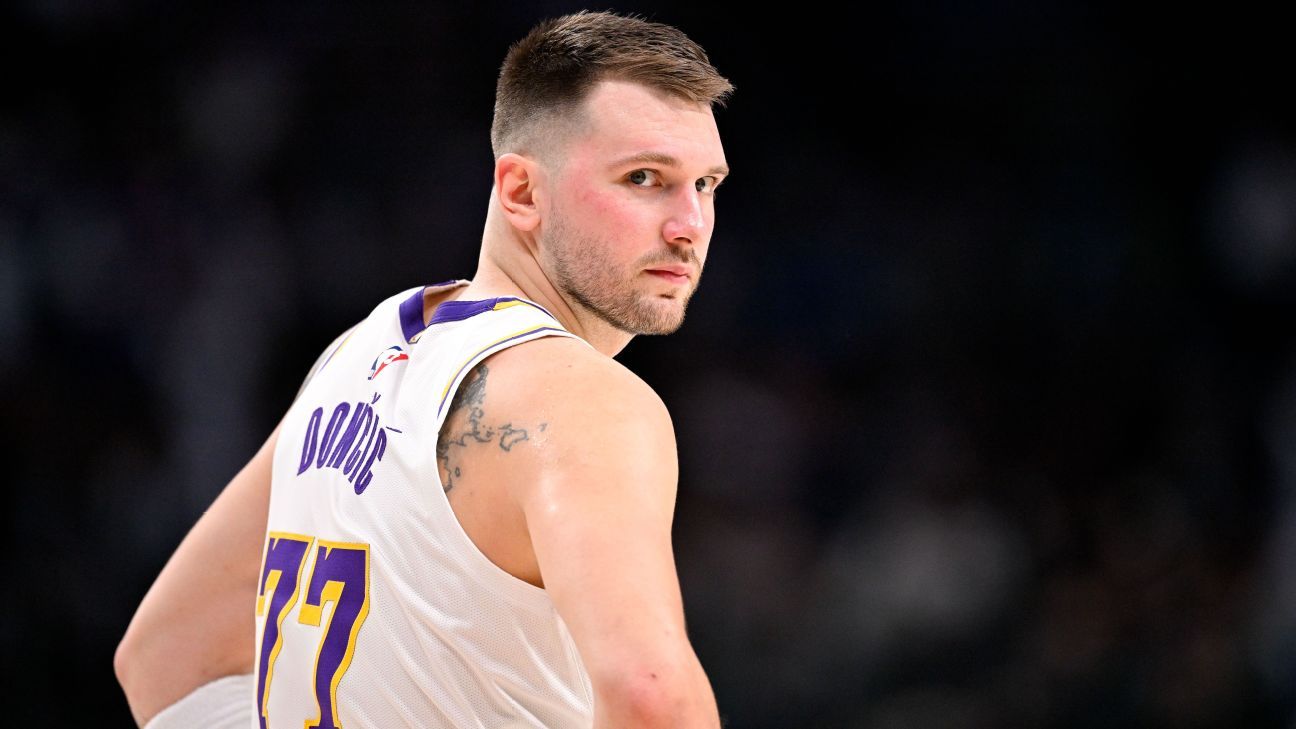
There had never been a trade like it in NBA history.
A perennial MVP candidate being blindsided and sent away midseason? In the season after carrying his franchise to the NBA Finals? As he’s approaching his prime?
One year later, the deal that sent Luka Doncic to the Los Angeles Lakers is still a stunner. And people around the league are still scratching their heads about the Dallas Mavericks getting what’s widely perceived as a pennies-on-the-dollar return, with all due respect to 10-time All-Star Anthony Davis.
“I’ve never seen a transaction that caused so much collective shock and confusion around the league,” a prominent agent, who didn’t have a client involved in the deal, recently told ESPN.
Our NBA insiders tackle four of the biggest questions facing the Lakers, Mavericks and the rest of the league on the one-year anniversary of one of the NBA’s most stunning deals.

Are the Lakers any closer to a title one year after the trade?
Hours before the trade went down last season, a Lakers’ win over the New York Knicks on Feb. 1 lifted their record to 28-19. This season, they came into New York on Feb. 1 with a nearly identical 29-18 record.
Does that mean the trade was a wash? Well, of course not.
The similar records have more to do with Doncic, LeBron James and Austin Reaves playing only eight games together this season because of injuries.
If there hadn’t been a trade, and Davis’ body suffered the same string of injuries over the past year — he has played 29 games total as a Maverick, while Doncic has played in 67 for the Lakers over two seasons — Los Angeles’ struggles this season could have been far more pronounced than they’ve been thus far.
It’s hard to see the Lakers as a contender — even with Doncic leading the league in scoring with 33.7 points per game — unless they can dramatically improve upon their 25th-ranked defensive rating.
That isn’t to say the Lakers can’t improve upon their spot in the West — they sit in fifth as Doncic, James and Reaves have returned to the court again. It isn’t suggesting that they won’t be a tough out in the playoffs, either, with those three calling the shots.
But, the only way this team gets significantly closer to a title this season is if it can pull off another early February trade ahead of Thursday’s deadline to address its 3-and-D deficiencies. — Dave McMenamin
How do the Mavericks move on from the short-lived AD era?
The “AD era” never really started in Dallas.
The second half of last season was an extended mourning period for Mavs fans. It took a remarkable stroke of lottery luck to resuscitate any hope for enthusiastic support from the morose fanbase.
As soon as the Mavs cashed in those 1.8% odds to win the No. 1 pick, it was clear that Cooper Flagg — not Davis — would be the franchise’s priority for the foreseeable future. Then the early-season firing of general manager Nico Harrison eliminated any doubt about the direction of the franchise.
In that sense, the Mavericks have moved on. Every personnel decision from this point will be viewed through the prism of maximizing the Mavericks’ potential to build around their teenage prodigy and his future.
That’s why the Mavs have spent the past few months exploring the trade market for the 32-year-old Davis, who clearly doesn’t fit the franchise’s long-term outlook.
Dallas — and specifically governor Patrick Dumont, who makes the franchise’s final decisions — needs to determine the threshold for pulling the lever on a Davis trade.
The ideal return in a Davis deal includes first-round draft compensation, young talent and financial relief in the form of expiring contracts. But don’t hold your breath waiting for that to happen before the deadline as Davis recovers from yet another injury — ligament damage in his left hand is expected to sideline him until at least late this month.
There are some within the organization who would be in favor of trading Davis even if the return is only expiring contracts, simply because they value the flexibility it would give the franchise as it builds around Flagg.
That idea would be hard to sell to Dumont, who feels no pressure to trade Davis now, sources told ESPN. — Tim MacMahon
How has the trade affected this year’s deadline?
To start, the architect of the trade, Mavericks GM Harrison, was fired in November.
The Mavericks under Harrison acquired Kyrie Irving, Daniel Gafford, PJ Washington and Davis over three consecutive deadlines.
With Harrison no longer in charge, the “win now” time frame — centered on Irving and Davis — is replaced with a focus on retooling the roster around Flagg and a potential lottery pick in June’s draft.
A decision on Davis’ future probably will wait until the offseason but that doesn’t rule out the Mavericks exploring options to reduce payroll in the future and opening a roster spot to convert two-way player Ryan Nembhard.
0:43
Windhorst: Mavs fired Nico Harrison to ‘save their brand’
Brian Windhorst explains the reactions and reasoning to the decision to dismiss GM Nico Harrison.
As for the Lakers, the Doncic trade has them operating on two timelines at the deadline.
The current timeline is adding to a roster with Doncic, James and Reaves while focusing on financial flexibility in future years. The Lakers have over $40 million of expiring contracts consisting of Rui Hachimura, Gabe Vincent and Maxi Kleber. They also have a 2031 or 2032 first-round pick to trade if needed. The future timeline is building a roster around Doncic and Reaves.
With Doncic under contract for the next three seasons, the Lakers could have up to $50 million in cap space this offseason and nearly double that amount in 2027.
They will also have three first-rounders (2026, 2031 and 2033) available to trade starting the night of the draft. — Bobby Marks
What are league insiders saying one year later?
The consistent theme I get back from people around the NBA whenever the trade comes up is the ongoing amazement that it happened — as well as how Dallas might dig its way out of the aftermath.
Harrison was fired as a result of the deal and the fallout from it, but Davis’ future is an ongoing talking point — his value is nowhere near what it was perceived to be when Harrison made him the centerpiece of the deal.
Fortunately for the Mavericks, they did get lucky to land Flagg in last year’s draft. Without Flagg, the franchise would be a desolate wasteland in a consistently competitive Western Conference.
At several points over the past few months, sources have reiterated to ESPN some variation of, “Can you imagine where Dallas would be if it hadn’t won the lottery?”
On the other side of the deal, the Lakers continue to be a work in progress. The irony of the Doncic trade is that over the couple of years preceding it, Dallas had done an excellent job surrounding him with exactly the sort of talent required to maximize his skills: a pair of rim-running, shot-blocking centers; 3-and-D guards and forwards to play defense and hit 3s around him; and another high-level shot creator to take pressure off him when he’s on the court while running the team when he’s not.
Los Angeles has the last part in Reaves (if he’s retained as a free agent this summer), but they are essentially starting from scratch on the rest of it.
And while they are the Lakers, and they’ll have cap space to build this team around Doncic, putting together a championship-level team in the West is a lot easier said than done. — Tim Bontemps
Source link