[This story contains MAJOR spoilers from the season two finale of The Night Manager.]
When he finally decided to revisit his Emmy-winning adaptation of the late John le Carré’s novel The Night Manager, writer David Farr knew he wanted two more seasons to craft a trilogy centered around the high-stakes game of cat and mouse between Tom Hiddleston’s weary soldier-turned-hotel-manager Jonathan Pine and Hugh Laurie’s morally corrupt arms dealer Richard Roper.
A decade after The Night Manager debuted as one of the most expensive limited series to be produced in the U.K., the spy thriller returned with an intricate plot that largely takes place in Colombia. Having successfully sabotaged Roper’s massive arms deal and turned him into Egyptian authorities at the end of season one, Pine has been living for years as Alex Goodwin, a low-level MI6 officer running a quiet surveillance unit called the “Night Owls” in London. Pine’s quiet, sleepy life is upended when he spots Jaco Brouwer, a mercenary formerly associated with Roper.
Despite orders from his superior, Rex Mayhew, to stand down, Pine begins an unsanctioned investigation through which he discovers the existence of a new arms operation led by Colombian businessman Teddy Dos Santos (Diego Calva). Pine quickly discovers that Teddy isn’t just a random player in the arms dealing market — he has been mentored by someone who, as one character put it, “learned from the best.” Just as Mayhew prepares to show Pine evidence of a high-level leak within MI6, he is found dead in his home, staged as a suicide. This forces Pine “off-book” to infiltrate Teddy’s operation in Colombia.
In Colombia, Pine crosses paths again with Roxana Bolaños (Camila Morrone), the woman he had tracked down and questioned in the wake of Mayhew’s death. Roxana, as it turns out, is a Miami-based shipping broker whose company, Barquero, is owned by Teddy. After noticing that something felt wrong about the cargo she was brokering for the company, Roxana approached Mayhew to report a series of suspicious shipments involving machine tools for oil pipelines being sent to Colombia from the U.K. Despite the fact that they could both blow each other’s cover, Pine uses Roxana to get close to the center of Teddy’s operation, which involves using illegally smuggled weapons to train a private guerrilla army.
At the end of episode three, Pine is quite literally confronted by the ghosts of his past. Despite being told by his former boss, Angela Burr (Olivia Colman), that Roper had been executed in Egypt years ago, Pine discovers that his nemesis is actually alive and has been operating in the shadows under the name “Gilberto Hanson” in Colombia. Coming face-to-face with Pine for the first time in nearly a decade, Roper reveals to Pine that he survived by bribing his captors and has been building a “disciple” in Teddy, who is his biological son.
Once his alias is revealed, Pine manages to get an irate Teddy alone and plays him secret recordings of Roper revealing his true intentions. He proves to Teddy that Roper never intended to acknowledge him as a true heir or to make him a key part of his future empire; Roper’s only loyalty has always remained with his other son, Danny (Noah Jupe), who is safe at a boarding school in England.
In the high-octane season finale, Teddy agrees to secretly team up with Pine to redirect the final shipment of weapons to an address where government authorities would be waiting to inspect the shipment themselves. But Teddy’s betrayal of his father comes at a great personal cost. After being tipped off by Roxana, who, in order to save herself, subtly suggests that Teddy has been working with Pine, Roper hatches a plan to use two different planes, sending the empty plane to the authorities and the real plane to the militants in the jungle. Just when Pine, Teddy and Burr finally seem to have the evidence to put Roper away for good for his crimes, Roper, with the help of corrupt MI6 official Mayra Cavendish (Indira Varma), manages to outsmart them all.
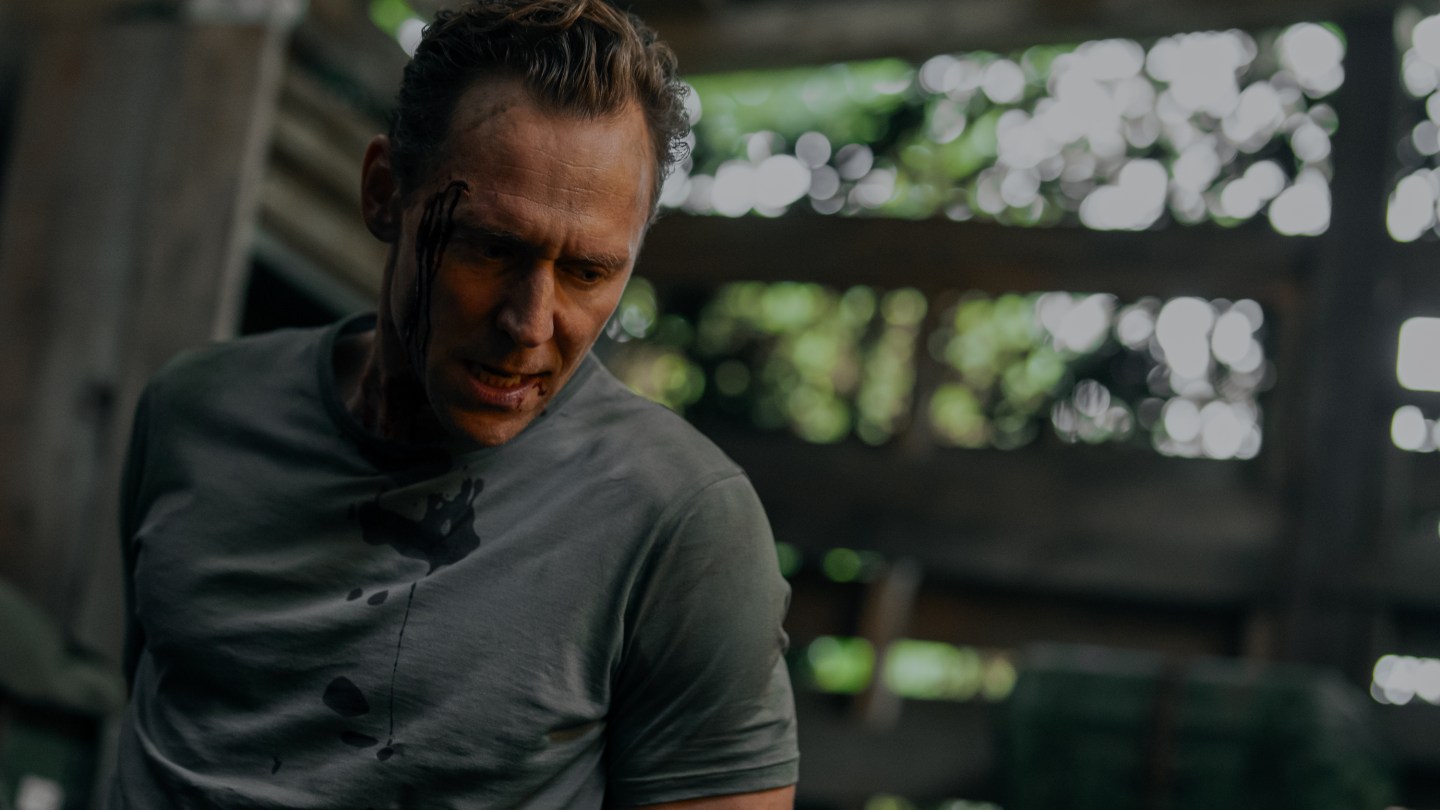
Roper fulfills his side of the agreement with the army and, in a final act of cruelty, shoots Teddy in the head for betraying him — all while Pine, who had his hands tied to maintain the illusion that he and Teddy had not been colluding with each other, watches helplessly. Following a dramatic shootout, Pine manages to escape with his life, but he is last seen collapsing in the middle of nowhere. To add insult to injury, Roper has not only successfully staged a military coup in Colombia, but he may very well be responsible for the killing of Burr, whose body is found on the ground by her young daughter in the final minutes of the finale.
In a wide-ranging chat, Farr answers all of The Hollywood Reporter’s burning questions after the season two finale — how a dream inspired the show’s trip to Colombia; the eerie parallels between Laurie’s Roper and current world leaders; the bittersweet decision to kill off Calva and Colman; and how that heart-wrenching cliffhanger sets up the final chapter of this story.
***
You have spoken about how the germ of the idea for season two actually came to you in a dream. What exactly did you see in that dream, and how did you think about building out the arc of the season from that original idea?
It was just simply the idea that Roper was a gun runner in Columbia in the ’90s. It felt very believable that he met a beautiful Colombian woman and had an affair, and there was this kid, and that was the image I had [in my dream]. Honestly, I have no idea why it came. I know what the image was — [a young Teddy] was waiting for Roper, and this black car comes over the hill, and it’s his dad. It’s a very le Carré [theme] about fathers and sons.
But then I half-woke up and the brain gets going. It’s like, “OK, it’s 30 years later, and Roper’s now going back there. He needs a place to hide out while he rebuilds his empire. He’s at an absolute low.” Suddenly, this felt like an emotional story, not plot — and this is why we didn’t do [the second season] in the first place. I just couldn’t find anything that had that le Carré depth of emotion. And then I thought, “OK, where would Pine be?” This took a little bit longer to work out — he was someone who decided to have a much more simple and almost gray life, and then, of course, Teddy awakened him from that.
I started to realize that there was going to be this almost Shakespearean story of two brothers, and this [magnetic] feeling between them. And then, could it become an attraction? And then there’s the realization for Pine that this is actually Roper’s son, and Roper is not dead. So now, the ghosts start to come up. That all felt very exciting. Very early on, I was sadly very clear about Teddy’s fate. It just felt absolutely clear to me that that is the story. There are other le Carré-type narratives where this kind of thing happens. It felt in the tradition.
What I didn’t have was all the plotting, because plotting is the stuff that takes time. It’s not actually the thing that everyone gets most excited about when they watch it, but you need the accuracy of the plotting to understand what people are actually trying to do. I also do really care about the effect of the arms industry — whether in arms smuggling or in arms deals. I think it was very important to honor the fact that The Night Manager is 100% a book about arms dealing. Le Carré was very angry about it. He was very concerned about it — and rightly [so]. Look at what’s going on now.
You recently confirmed that you never intended to make a second season of The Night Manager without Hugh Laurie. At what point during the writing process did you decide that Roper had faked his death and was actually hiding in Colombia?
What I’m proud about is that we managed to keep it secret. [Laughs.] I can’t believe we did that, which is great. [I decided that Roper was alive] very early on because it was such a simple idea that he would hide away. There was a decision to be made about when to reveal him. That was the discussion that took a bit more time, because you could do it earlier or later. We went for a very traditional solution. [We introduced that twist] halfway through — I’m a theater man, so just before the interval.
Hugh really loved it because he really understood it himself. I remember him saying, “You’ve done something very simple. I didn’t really ever understand how [Pine and Roper] could get back together quickly, and you’ve solved it by not getting us back together quickly.” So it felt like everyone’s instincts were going in the same direction. But I’ve created [this arc] as not just a season two in my head; it was a season three as well. So it is fundamentally the story of these two men, and it will continue to be so.
The dynamic between the central trio initially felt like a classic love triangle with Roxana at the center, but then there were moments here and there where Pine and Teddy were on the verge of some kind of romantic connection. In the finale, Roxana tells Roper, “[Pine] is so easy to fall in love with, but I chose not to. Maybe I was wise to his true intentions, or maybe I’m just not capable of love. But either way, I didn’t lose my heart to him. And if someone did, it wasn’t me.” That implies that Teddy lost his heart to Pine at some point.
There was a misdirect here. Even in the marketing, it looked like Roxy would be the kind of Bond girl heroine [for Pine], and there might also be a kind of homoerotic thing with Teddy — which I think there is! But, actually, Roxana is much tougher. She’s very wounded by her past, as they all are. Those three are all orphans of different kinds. But she’s a survivor, so she makes some very tough decisions in the second half [of season two], which are basically aimed at her own survival.
I’m so happy you mentioned that speech, because it’s the moment Roper realizes that he’s been looking in the wrong direction. She says, “I didn’t lose my heart to him, and if someone did, it wasn’t me.” And if you look at Roper’s face, it’s completely clear that in that moment — and [Laurie] does it so well — where he goes, “Ding!” Maybe we played this carefully because we didn’t want people getting it too quickly, but from that moment, he’s on to it.
What I love is that Roxana and Roper end up looking at each other in that later scene when they’re in the living room together, and it’s clear they see each other as, “OK, you’re like me, actually.” She talks about the fact that “My father was an idealist, but I’m not that. His death cured me of those illusions.” So Roper and Roxy end up as one [unit]. And, weirdly, it’s Teddy and Pine who end up being people who still have hopefully the good illusions [or] delusions that the world can be a better place, that things can be solved. In this season, they fail. And for Teddy, it’s a tragedy.

Tom Hiddleston (Jonathan Pine) amd Hugh Laurie (Richard Roper) in season two.
Prime
You mentioned the living room scene where Roper tells Roxana, “I pride myself on being an adaptable man. When circumstances demand, I shed a skin, pick up a new one. No regrets. No nostalgia for the past. Nothing is so precious that it can’t be sacrificed. Nothing and no one.” It’s a speech that continues to haunt Roxana even as she boards the plane back to Miami. What exactly is the significance of that speech?
We tried to make it coded, but essentially he’s saying, “Teddy is that skin, and I’m shedding it.” It’s that simple. That’s what he means; that’s what’s inside his head. So, therefore, once you’ve shed the skin, you can then shoot him in the head. But you have to shed the skin. [Roper] can do it. I couldn’t do that. I hope you can’t do that [either]. [Laughs.] But maybe Roper is just a more honest person. There is no relationship [where] if something happens, such as a betrayal, you can’t shed the skin. Maybe there’s an honesty to that. I find it terrifying, but I know that it’s playable. Hugh is nothing like that, but he understands it. So he can play that mentality. It seems to be a mentality that’s quite prevalent in the world.
Towards the end of the finale, Teddy has an opportunity to shoot Roper in the head point blank, but he is unable to bring himself to pull the trigger — and everything quickly goes downhill for Teddy and Pine from there. Why do you think Teddy is unable to execute Roper?
It is about exactly what we’ve just said — Teddy’s not someone who can shed skins in the same way. Obviously, it’s complex because he’s also losing control of the scene. He’s suddenly aware that everything is not going to plan, that Roper has cards up his sleeve, that the plane is not what he thinks the plane is. Everything’s falling apart. So he would get riddled with bullets if he did [shoot Roper], but he misses his chance because he’s not that person. He’s not that ruthless person who can shed the skin. And then, of course, he discovers that his father is.
You have a very high dead body count in the finale — Teddy; Juan Carrascal (Unax Uglade), a lawyer working for the Dos Santos; Martín Álvarez (Diego Santos), a Colombian PI hired by Pine; and even Angela Burr. How did you settle on which characters you wanted to kill off in the finale?
The others were part of the storytelling in a weird way, but the Angela [death] was obviously a huge decision and one that was taken after a lot of thought and discussion with Olivia. I felt she’d had such a good story in both season one and season two. For season one, she’s this good angel in Pine’s ear. She cares so much about him. She’s haunted by Roper. In season two, she’s made this flawed decision to lie [to Pine about Roper not being dead], and I think it haunts her. So she has this difficult [confrontation] scene with Pine, and then she redeems herself. I think, in a sense, her final act is an act of self-sacrifice, in a strange way.
What I didn’t want to do was to try and keep going [with the character], but not have enough of an emotional engine to keep that going for another season. Also, [Colman] is incredibly busy, so it was just like, “Let’s do it properly [if we kill her off].” I can’t say too much, but her legacy in season three is quite strong for a very specific plot reason. So, although she’s dead, there is something in store in terms of what her legacy is for Pine. He doesn’t even know she’s died at the end of this [season].
That was the [death] we took very seriously, and it was very bittersweet for everyone because she has lived with the show. She was genuinely pregnant when she was playing pregnant Burr [in season one], so her fictional child obviously sees her die, but her real child is the same age as the show. It’s a very emotional thing for all of us, but massively for her.
Roper was already a morally dubious character in the first season as an international arms dealer, but he crosses even more lines this season in order to carry out this coup in Colombia. He shoots three of his dogs after finding a voice recorder on one of them. Pine calls him out for demanding love by tyranny, and Roper fully embraces the power and influence that he can lord over others. Did you ever have any conversations with Hugh about how far you both wanted to push this character? Did you want Roper to reach the point where he absolutely cannot be redeemed?
In a serious sense, Hugh wants Roper to be as bold as Roper is. The dogs were very important because they act as a kind of presentment to the viewer of the state of mind that’s actually sitting behind Roper. Both of us were interested in a very simple thing: He’s traumatized. He’s not as in control as he was in season one. He hasn’t got his court around him of sycophants and friends. He’s alone. He’s a slightly hunted animal. He doesn’t know if he can get back. He’s still got, on the surface, the classic British thing — all the cool elegance, the cocktails, the dogs — but it doesn’t take much for that to crack. Anyone who crosses him, even a dog who doesn’t know that it has a microphone in its collar — well, that [ruthlessness] can happen.
My favorite bit of acting is a very small piece just after he’s killed the dogs where he’s got the gun, and then you see, for a moment, a guy who’s genuinely at sea and wants to be on his own. He doesn’t really understand what is going on, even inside his own head. He’s not in control, and it’s such a nuanced performance. It’s so utterly believable. So it’s a very real thing, but it gives us a presentment of what then happens in episode six.
Is he irredeemable? I think that’s a really interesting question. Teddy has done terrible things in his life, but he’s clearly redeemable. Maybe that’s an interesting theme for season three…
The world has changed significantly socially and politically in the decade since you made the first season of The Night Manager. What were some of the parallels that you noticed, when crafting the season, between Roper and some of the current world leaders?
It was already true a little bit in season one. But here in season two, I remember, when I was writing the big scene between [Pine and Roper in episode five] when they’re sitting having their steak together, this clash of values. Roper was very clearly saying, “Your values are dying. Mine are in the ascendancy.” That felt pretty truthful when I wrote it, which was a good two or three years ago. It feels much more truthful now.
Obviously, none of us predicted what would happen in Venezuela, literally the week we opened our show. That was quite strange. But there is unfortunately a renaissance of despotic rule across the globe, which is going under a slightly fake banner of populism. Putin obviously has been the early pioneer of it, but I’m afraid, yeah, your president [Trump] is probably part of it. Certainly, we can see lots of cases in Europe where it’s taking root, and we have to ask questions about what kind of world we want.
I think the recent speech by the Canadian prime minister Mark Carney [at the World Economic Forum] is interesting in that regard. He’s admitting some pretty basic truths. So, yeah, we are a television show, and we are not claiming to be wise seers of the world, but you can’t make a show about the arms industry and how much money is in the arms industry without saying, “Look, these things are all connected, and at some point, these chickens come home to roost.” I did notice a very simple thing. When there was a genuine rumor — which, of course, is no longer true — of peace in Ukraine, arms companies’ share prices across Europe, and I think in America too, plummeted. I think that raises important questions.
Pine’s no angel; he’s no perfect character. But at some level, he’s fighting for a world that perhaps we all should be fighting for too. Roper definitely has become a far more paradigmatic character than even le Carré could’ve predicted. I think le Carré would’ve seen Roper as the rogue underbelly of a slightly sick world — but now, he’s out front, isn’t he? That’s interesting, and it presents interesting challenges for me as a writer in terms of where to take [the characters] next.
You and Tom Hiddleston have both talked about The Night Manager as a trilogy. The second season very much feels like the end of the second book in a trilogy, with the bad guy coming out on top. Where are you in terms of production on the third season, and how does this ending help propel you into the next (and possibly final) chapter of this story?
The simple answer is, I’m writing it now. We’re not rushing. We’re very grateful to both BBC and Amazon that we’re not being rushed. We won’t take as long as last time. [Laughs.] But we’re writing it. I can’t yet say when production exactly is going to be, but we’re in the writing process. It’s enjoyable. It obviously has to and will deal with the emotional legacy of the deaths we’ve already discussed. It obviously centers around these two wonderful actors and will take that relationship to whatever conclusion I choose to go to.
I would also just mention that Noah Jupe, who plays Danny, is going to play a really important role in it for fairly obvious reasons. He’s a wonderful actor, and I’m really excited to write for him. So there’s a new energy coming into the show via him, which is really exciting. I think we’ll do it in a way that not everyone would predict.
Do you still see this show as a trilogy, or do you think this show could go beyond that?
I’m sure not everyone agrees with me, but I see it as a trilogy. [Laughs.] No, I genuinely do. It’s not like a police procedural — that [genre] personally doesn’t interest me. I want to make a really epic and really classic piece of television that has a genuine architecture to it. And, as you said, at the end of the second [season], Roper wins. So now we are set up, and it feels like [season three] has to work as some sort of final showdown.
***
The first two seasons of The Night Manager are now streaming on Prime Video.
Source link