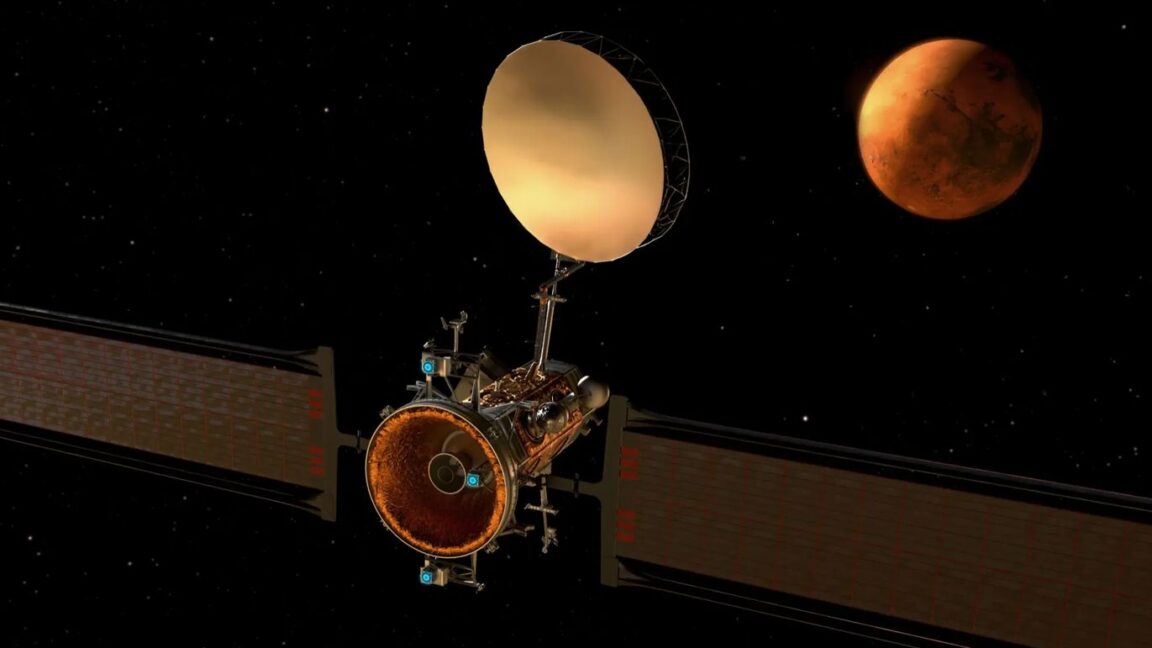
However, some leaders within NASA see the language in the Cruz legislation as spelling out a telecommunications orbiter only and believe it would be difficult, if not impossible, to run a procurement competition between now and September 30th for anything beyond a straightforward communications orbiter.
In a statement provided to Ars by a NASA spokesperson, the agency said that is what it intends to do.
“NASA will procure a high-performance Mars telecommunications orbiter that will provide robust, continuous communications for Mars missions,” a spokesperson said. “NASA looks forward to collaborating with our commercial partners to advance deep space communications and navigation capabilities, strengthening US leadership in Mars infrastructure and the commercial space sector.”
Big decisions loom
Even so, sources said Isaacman has yet to decide whether the orbiter should include scientific instruments. NASA could also tap into other funding in its fiscal year 2026 budget, which included $110 million for unspecified “Mars Future Missions,” as well as a large wedge of funding that could potentially be used to support a Mars commercial payload delivery program.
The range of options before NASA, therefore, includes asking industry for a single telecom orbiter from one company, asking for a telecom orbiter with the capability to add a couple of instruments, or creating competition by asking for multiple orbiters and capabilities by tapping into the $700 million in the Cruz bill but then augmenting this with other Mars funding.
One indication that this process has been muddied within NASA came a week ago, when the space agency briefly posted a “Justification for Other Than Full and Open Competition, Extension” notice on a government website. It stated that the agency “will only conduct a competition among vendors that satisfy the statutory qualifications.” The notice also listed the companies eligible to bid based on the Cruz language: Blue Origin, L3Harris, Lockheed Martin, Northrop Grumman, Rocket Lab, SpaceX, Quantum Space, and Whittinghill Aerospace.
Source link