There are still problems to sort out: Ortu’s calcium electride is too air- and water-sensitive for use in industry. He is now looking for a more stable alternative, which could prove particularly useful in the pharmaceutical industry to synthesize drug molecules, where the sorts of reactions Ortu has demonstrated are common.
Still questions at the core
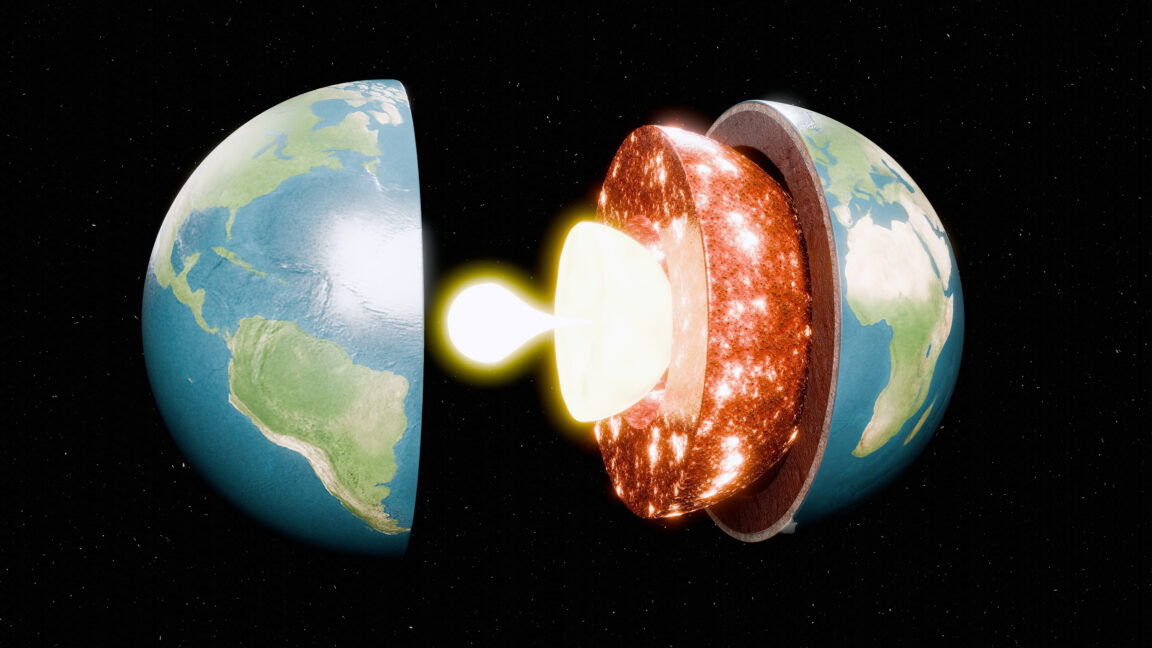
There remain many unresolved mysteries about electrides, including whether Earth’s inner core definitely contains one. Kim and his collaborators used simulations of the iron lattice to find evidence for non-nuclear attractor sites, but their interpretation of the results remains “a little bit controversial,” Racioppi says.
Sodium and other metals in Group 1 and Group 2 of the periodic table of elements—such as lithium, calcium, and magnesium—have loosely bound outer electrons. This helps make it easy for electrons to shift to non-nuclear attractor sites, forming electrides. But iron exerts more pulling power on its outer electrons, which sit in differently shaped orbitals. This makes the increase in electron repulsion under pressure less significant and thus the shift to electride formation difficult, Racioppi says.
Electrides are still little known and little studied, says computational materials scientist Lee Burton of Tel Aviv University. There is still no theory or model to predict when a material will become one. “Because electrides are not typical chemically, you can’t bring your chemical intuition to it,” he says.
Burton has been searching for rules that might help with predictions and has had some success finding electrides from a screen of 40,000 known materials. He is now using artificial intelligence to find more. “It’s a complex interplay between different properties that sometimes can all depend on each other,” he says. “This is where machine learning can really help.”
The key is having reliable data to train any model. Burton’s team only has actual data from the handful of electride structures experimentally confirmed so far, but they also are using the kind of modeling based on quantum theory that was carried out by Racioppi to create high-resolution simulations of electron density within materials. They are doing this for as many materials as they can; those that are confirmed by real-world experiments will be used to train an AI model to identify more materials that are likely to be electrides—ones with the discrete pockets of high electron density characteristic of trapped electron sites. “The potential,” says Burton, “is enormous.”
Knowable Magazine, 2026. DOI: 10.1146/knowable-012626-2 (About DOIs)
“This article originally appeared in Knowable Magazine, a nonprofit publication dedicated to making scientific knowledge accessible to all. Sign up for Knowable Magazine’s newsletter.”
Source link